The Growing Impact of Private LoRaWAN Network Servers on Corporate ESG Data Infrastructure in the $18.7 Billion LoRaWAN Gateway Market
Private LoRaWAN network servers are becoming increasingly important for the industrial digitalization process as they allow companies to control data collected from sensors in a more systematic manner. Given that some companies are focusing on collecting data related to their sustainability efforts, efficiency, and compliance measures, private LoRaWAN becomes an excellent base to create ESG data collection systems.
There is a need for more and more data to be generated by industries. This data comes from such sources as energy metering, air quality sensors, water monitoring sensors, vibration sensors, and asset tracking nodes. All of them require a network that will offer wide coverage, low power consumption, and stable connection. Since Private LoRaWAN has the capabilities of wide area coverage, low power usage and stable connectivity, it is considered the best option for industrial Internet of Things usage.
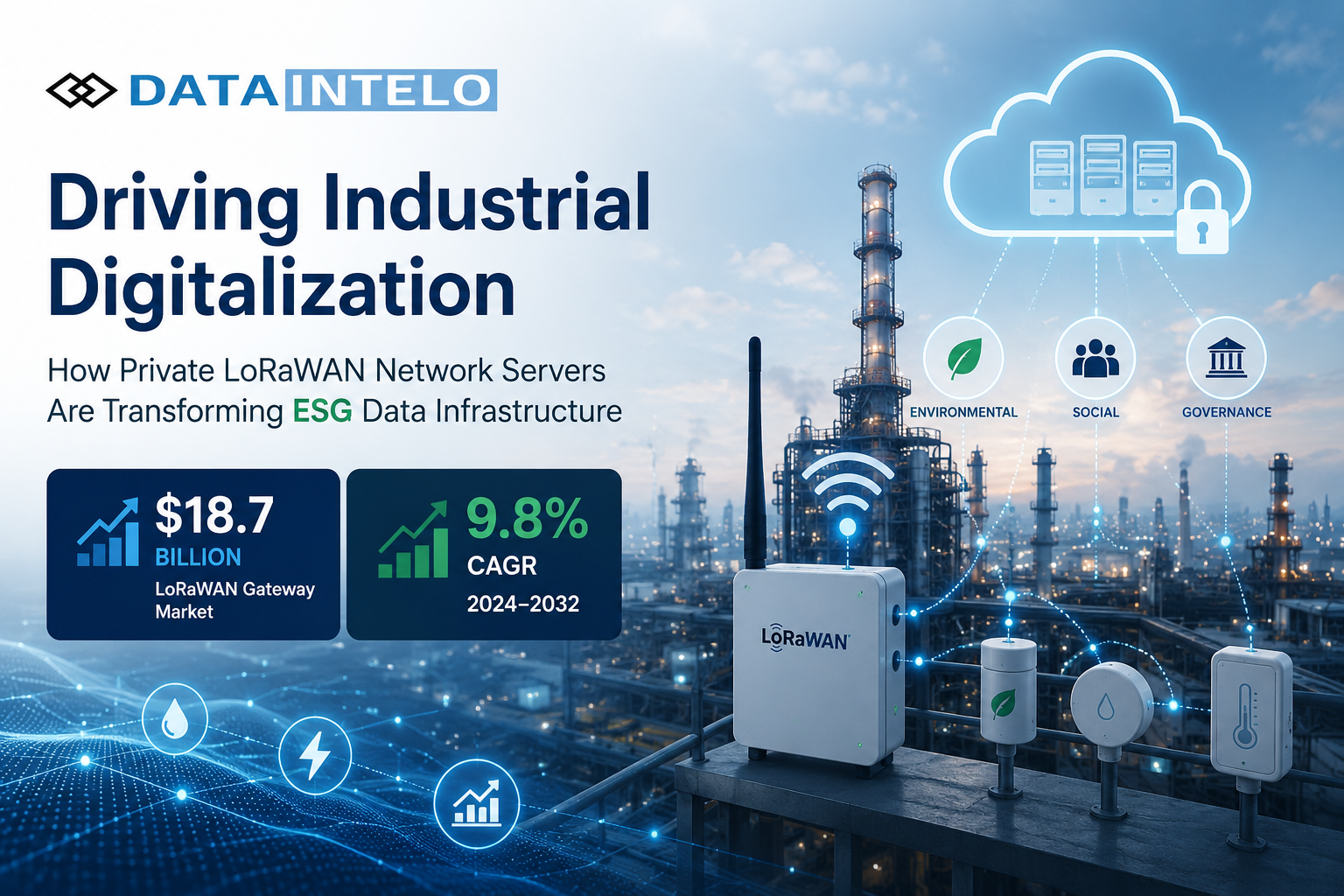
A timely DataIntelo report indicates that the worldwide LoRaWAN Gateway Market
was worth around USD 8.9 billion as of 2025 and is expected to have a value of USD 18.7 billion by the year 2033.
Image Title: Driving Industrial Digitalization; Image Credit: Data Intelo https://dataintelo.com/
One of the key benefits of the private network server is data ownership. The ESG reporting relies on proper record keeping which requires consistency, traceability, and security of the telemetry. Sensor data kept within the boundaries of a private network will allow enterprises to keep control over their data through setting up retention and validation mechanisms independently from the cloud environment.
That becomes extremely important for sectors like manufacturing, logistics, energy, mining, and large-scale commercial real estate. In these industries, the scope of activities is quite wide, and there is a need for a significant number of sensors to be online simultaneously. The use of a private LoRaWAN network decreases costs associated with this process as opposed to using the cellular networks.
Why ESG teams are paying attention
For ESG teams, there is increasing pressure to convert operational actions into quantifiable measurements of those actions. This is measured in terms of energy consumption, emissions monitoring, waste management, water use, and equipment efficiency. The private LoRaWAN network server helps here in making it simpler to collect continuous field data from various locations and consolidate that data into one reporting layer.
There is more at stake than merely technological factors. Businesses that have the ability to identify energy spikes, leakage, or any other environmental irregularities in real time are much better able to minimize wastage. This is why having private wireless infrastructure is becoming more than simply an IT issue.
Typical enterprise use cases
LoRaWAN private networks have a plethora of use cases across various industries, as well as in the field of ESG.:
The supervision of utility consumption, such as electricity, water, and gas in industrial facilities.
Environmental observation, including temperature, humidity, air quality, soil conditions, and water resources.
This list of use cases is particularly relevant due to the fact that all of them involve small data packets sent periodically rather than large amounts of data. Thus, such technology is perfect for battery-operated sensors which have to work continuously for several years without any recharge.
Industrial modernization and increasing IoT adoption
Smart city investments, infrastructure development, economic diversification
The patterns of adoption vary based on the level of industrial maturity, the nature of the regulations in place, the amount invested in digital transformation, and the rate of IoT deployment. Europe has been able to take the lead in the use of private LoRaWAN technology largely due to strict guidelines relating to sustainability as well as the rising need for monitoring energy consumption and emissions. The growth of the market in North America is driven by the use of automation in industries, logistics enhancement, and management of high-tech facilities. The Asian Pacific region, on the other hand, is growing at a very fast rate thanks to increased industrial growth, smart manufacturing programs, and smart city projects. In emerging regions like Latin America and the Middle East & Africa, advancements in connectivity and growth in digitalization with the help of investment in digital infrastructure play crucial roles in boosting growth.
The requirements for deployment usually change according to the dimensions of the facility and complexity of the facility.:
While these numbers depend on factors like terrain, number of buildings, and level of interference, they demonstrate how the private LoRaWAN network solution scales from a single site operation to multiple sites.
Data architecture advantages
The use of a private network server adds value to the ESG data architecture by providing a clearer route for data collection and processing. By collecting raw data via a private network server, an organization can ensure its filtering, validation, and enrichment before it reaches third-party platforms.
This enables organizations to integrate their network data with analytics, sustainability, building management, and asset-management platforms. Thus, operational and ESG teams have a unified view of operations rather than scattered reporting.
A typical business case for private LoRaWAN relies on four elements:
Lower connection costs for low-data endpoints.
Better control over endpoint security and data management.
Better scalability for big or dispersed sites.
More conformity with sustainability guidelines.
In the long run, this will decrease the need for manual inspections, save energy, and increase the lifecycle of assets. If an organization needs to manage hundreds or even thousands of endpoints, the main value is often in improved operations before sustainability reporting.
LPWAN network markedly contributes to private LoRaWAN infrastructures being built in industrial environments. It assures the consistent presence of connectivity for remote devices, meters, sensors, or trackers without necessitating the extensive installation of networks or regular battery replacement. For enterprises concentrating on ESG performance, LPWAN helps in advancing operational data while keeping connectivity charges low.
Industry outlook
With the increasing pace of digitization of industries, private wireless networks are going to become increasingly prevalent in the context of ESG infrastructure. Businesses require systems which are reliable, power-efficient and scalable while maintaining visibility. The role of private LoRaWAN is to connect the real world with the digital world, consisting of analytics and reporting.
The further development will be characterized by edge computing, advanced device analytics and sustainability software integration. By approaching the issue of connectivity as an element of the ESG strategy, businesses will be able to create effective reporting systems and manage risks more efficiently.
Conclusion
Private LoRaWAN server networks are now feasible to become a layer of infrastructure for company ESG data collection due to their scalable nature and ability to provide low power connectivity. For companies looking to digitize operations and get sustainable practices more visible, they provide an opportunity to gather reliable field data and derive insights from them.
The most effective implementations will be those that integrate technological considerations with reporting needs from the beginning. With proper planning, private wireless networks can become a strategic asset for years to come.